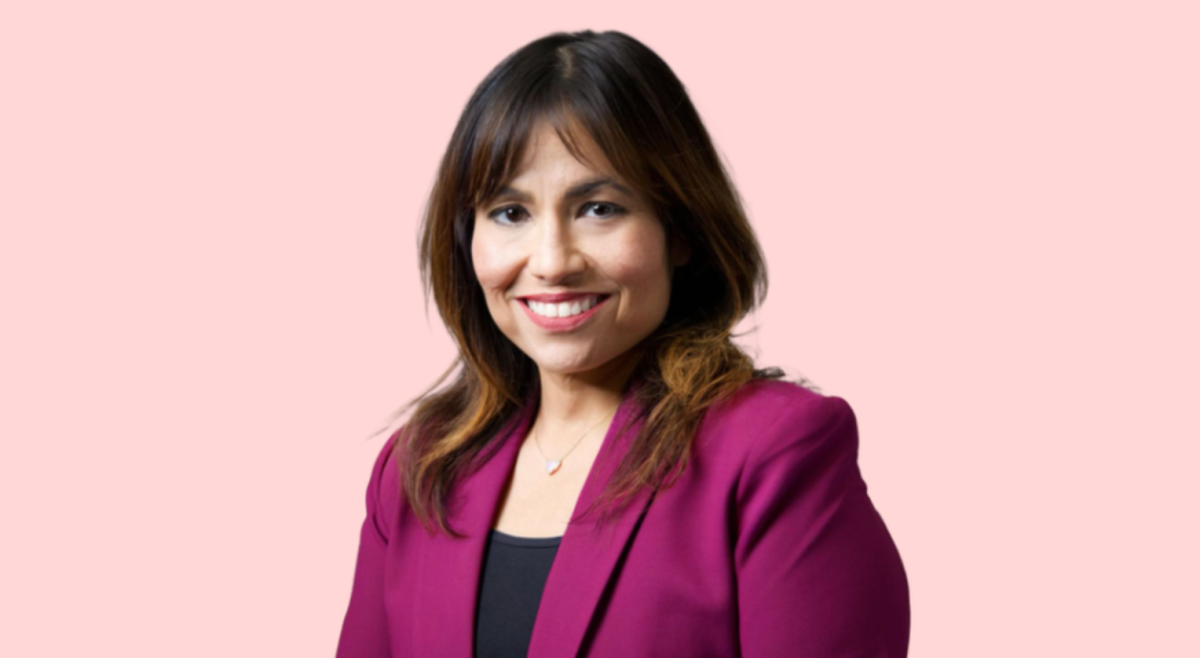
Stella Flores grew up in a family that valued the power of an education.
“My mom and my grandparents were farm workers, so education was very big for them,” Flores said. “They told their kids you need to get an education unless you want to do farm work.”
Flores saw education as a path to success. Last fall, after dedicating her career to ensuring that all students have access to educational opportunities, Flores was named the John E. Cawthorne Millennium Chair professor in Boston College’s Lynch School of Education and Human Development (LSEHD).
Originally from Edinburg, Texas, Flores was inspired by her mother’s commitment to schooling.
“My mom was a teacher,” Flores said. “She got her first good high school degree and then a college degree. She ended up getting a master’s. And it was all about education, education.”
From a young age, Flores witnessed the impact of human rights activism. Her mother’s family fought for farm worker rights in the United Farm Workers movement, and Flores grew up attending rallies and marches supporting the cause. Flores also observed advocacy from a legal standpoint through her father’s job as a social worker.
Motivated by these experiences, Flores realized her purpose in life centered around service.
“I knew I wanted to do something that helped people,” Flores said.
This early exposure, as well as her family’s emphasis on education, shaped the beginnings of her career. Flores attended Rice University for her bachelor’s degree, where she double-majored in sociology and Latin American studies, she said.
After graduating in 1996, Flores worked for a nonprofit that helped people safely build homes, ensuring they weren’t constructed on toxic land. She also worked as an auditor in the U.S. Congress—an experience which she said was influential in shaping how she approached and analyzed evidence.
“I use training from every sector of my life,” Flores said. “What can I learn that will benefit the common good? And I’m an analyst. I use my intellect to help people the best way I can.”
Working in policy wasn’t always the plan. Flores said she initially considered going to law school, but became interested in demography—especially how different demographics and communities change over time, and if certain policies caused those changes.
“I was interested in what happens to immigrant communities or Latinos or women,” Flores said. “Especially like, ‘What are the demographics of Latinos in terms of their educational attainment, right? What kind of jobs do they get?’”
With these questions in mind, Flores decided to attend the Lyndon B. Johnson School of Public Affairs at the University of Texas at Austin.
“I saw how there were different disciplines working on problems that mattered, and getting that research to lobbyists and legislators, people who voted on things,” Flores said. “If there’s a bad law, you can create research to retract it because it’s not only about creating a new law. You can also show that a law is harming people, and you can try to do something about it, to remove it.”
Flores’ policy research has spanned a spectrum of educational demographics, from kindergarten students to the university level. She has particularly examined how U.S. policy impacts college access and success for underrepresented and immigrant students across the country.
As BC’s John E. Cawthorne Millennium Professor, Flores hopes to expand upon this research. She is the second holder of the position, succeeding Marilyn Cochran-Smith.
“It was a huge honor to be able to be offered this position,” Flores said. “I looked up who Dr. Cawthorne was, and it was this very impressive person that students loved. So I had big shoes to fill.”
Flores has continued this legacy, using her role to work towards greater access to education.
Gael Gil Garza, a doctoral student and Flores’ graduate research assistant, emphasized that Flores puts students first.
“She always centers students in everything that she does,” Garza said. “In all of our meetings and all of the work that we’ve done together, she always centers the benefit of students first.”
In her position, Flores uses quantitative methods to understand how factors like immigration and citizenship status shape educational outcomes for students.
“I knew I wanted to study educational access mostly through quantitative methods,” Flores said. “I’m interested in why some people get access and whatnot. I knew money had a lot to do with it, but also historical policies about race and gender.”
By combining research with her personal experiences in activism and education, Flores works to strengthen her commitment to students.
“She always brings her perspective and also the student’s perspective and the student’s point of view,” Garza said. “That, to me, has been the most meaningful part of just learning from her.”
Flores’ work continues to focus on ensuring educational access for all students, regardless of their background. She expressed that communication is a key factor in this process.
“I think we need to be working with elementary schools, with teachers,” Flores said. “We need to have constant communication: ‘What are you seeing on a daily basis? What are the parents saying to you? How are jobs changing?’ We need to get out of our bubbles and have conversations.”
According to Sasha Smith, a doctoral student and graduate research assistant who works closely with Flores, change in education comes from people like Flores who are willing to study, confront, and fight to improve policy structures.
“You can’t change the education sector without broadening your scope. It’s too much a part of the multi-system jumble we’re all living in,” Smith wrote in an email to The Heights. “That’s what Stella does, and that’s why her work matters.”
According to Smith, Flores’ work is needed now more than ever.
“I think Stella’s work is the kind we need more of right now,” Smith wrote. “Rigorous, expansive, change-oriented, and unafraid. She’s exactly the kind of researcher I hope to be. Someone who uses their education in fighting for better systems that allow future generations to do the same.”
For Flores, education is more than just a system—it’s a human right that all are entitled to.
“People forget the dignity of the human being and their right to have an education, to exist and work and be and live in this country, or at least have the opportunity to be educated,” Flores said. “I can’t imagine not having the professors I had because they were not allowed to teach what they taught me—I’d be a completely different person. So I’m grateful for the opportunity to be able to do that here.”