Over the past year, actions taken by President Donald Trump’s administration have framed public media’s role as a divisive and partisan issue.
But Katherine Maher sees public media as something that should look to bridge social or political divides.
“No one puts a CNN bumper sticker on their car,” Maher said. “There is a deep, emotional relationship that people have with the idea of being someone who participates in the public media.”
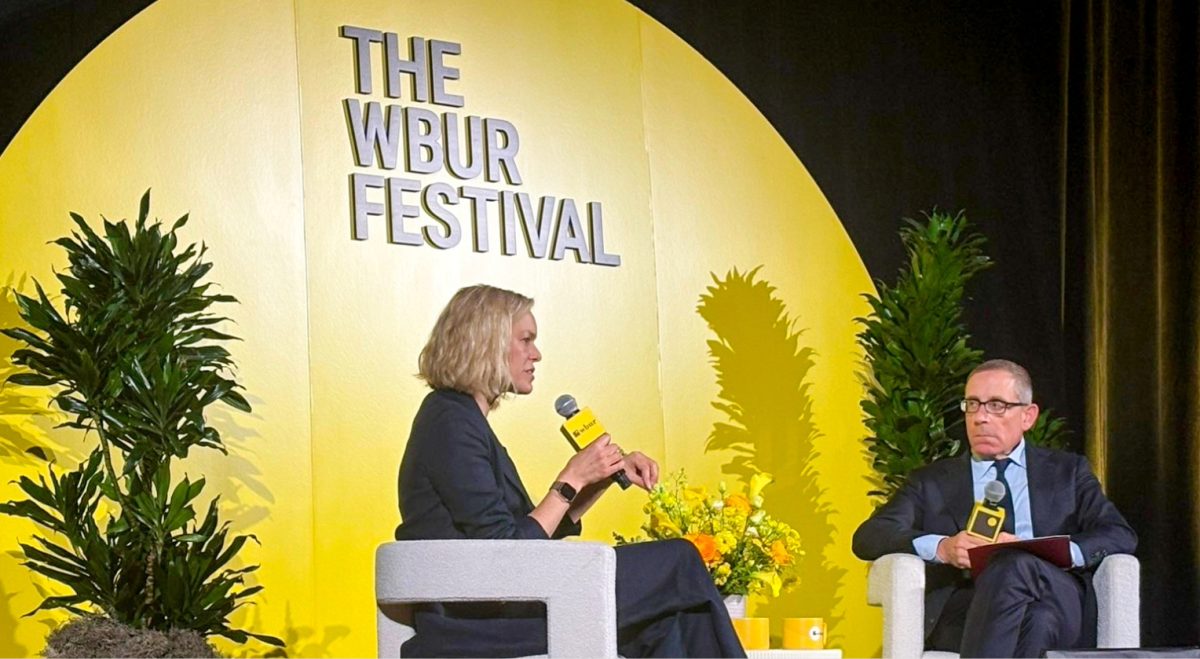
Maher, who has served as the president and CEO of National Public Radio (NPR) since 2024, sat down with The Atlantic’s Evan Smith on May 29 as part of The WBUR Festival in Boston.
Before NPR, Maher was the CEO of the Wikimedia Foundation for five years and served as an adviser to the U.S. Secretary of State’s Foreign Affairs Policy Board from 2022 to 2024.
Maher began her talk, which was moderated by Smith, by discussing the May 2025 defunding of public media by Trump and Congress, which ultimately cut $1.1 billion worth of funding to the Corporation for Public Broadcasting, $120 million of which went to public radio.
“When federal funding was taken off the table by Congress in their decision last year, we knew that there would be a series of consequences,” Maher said.
Those consequences have manifested in recent weeks, as NPR has had to reduce its workforce by 36 people through layoffs, buyouts, or by leaving empty positions unfilled. But Maher is confident that those cuts will end in the near future.
“You have to do [these cuts] in a way that prevents you from having to go back to that well,” Maher said. “Our goal was to do that. We believe we’ve accomplished that.”
But with the American public’s trust in media at an all-time low—just 28 percent, according to a recent Gallup poll—Maher sees NPR’s preservation of local media as an important way to keep Americans trusting the news.
“Eighty-five percent of Americans think that local public, not just public media, but local media, is trustworthy and adds value to their community,” Maher said. “The presence of local media is an indicator of lower rates of polarization, greater rates of trust in democratic institutions, but also in your neighbors.”
With this trust in mind, Maher discussed how people’s decline in radio consumption and changing work habits have forced NPR to adapt its news distribution.
“We are moving to a model that really encourages digital engagement,” Maher said. “We need to have a digital relationship, because that is where we are today.”
She went on to acknowledge that this movement will force NPR to overcome some of the issues it has had in the past with online coverage.
“There’s a way in the past that the network competed against itself when it came to digital,” she said. “Now my view is that we have to bring everybody together into a singular platform and place where we’re able to say that, you know, all these folks may be consuming information or engaging with everything from Tiny Desk, Morning Edition to your local public affairs show, but they’re doing it in a home that feels like public radio.”
According to Maher, the goal of public media—specifically public radio—is simple: to reduce polarization and get people to recognize each other as people.
“Audio requires you to hear someone—it requires you to listen,” Maher said. “And when we do our work best, we are asking you to listen to someone who you might fundamentally disagree with and also you cannot deny their humanity. That is what public radio can do.”






Sandra • Jun 20, 2026 at 9:39 am
I am making a good salary from home $4580-$5240/week , which is amazing under a year ago I was jobless in a horrible economy. I thank God every day I was blessed with these instructions and now its my duty to pay it forward and share it with Everyone,
Here is I started_______ Homeprofit1.site